Sunday, November 17, 2013

#24 Bob Bruce


Bob Bruce signed with the Detroit Tigers in 1953. The righty pitcher took a long slow trip up the Tigers' minor league ladder and spent a year in the military before he finally debuted in September of 1959. His first appearance that year was a one inning mop up stint in which he walked two. He returned to the mound on September 27 making his first career start. It was against the White Sox at Briggs Stadium and Bruce was treated pretty shabbily, and not just by the Sox. Here is the Baseball Reference play-by-play for the top of the first:

Top of the 1st, White Sox Batting, Tied 0-0, Tigers' Bob Bruce facing 1-2-3
t10-00---CHWL. AparicioB. Bruce

Single to LF
t10-001--CHWN. FoxB. Bruce

Aparicio Steals 2B
t10-00-2-CHWN. FoxB. Bruce

Aparicio Steals 3B
t10-00--3CHWN. FoxB. Bruce

Walk
t10-001-3RCHWJ. LandisB. Bruce

Reached on E6 (Ground Ball); Aparicio Scores; Fox to 2B; Landis to 1B
t11-0012-CHWT. KluszewskiB. Bruce

Wild Pitch; Landis to 2B; Fox to 3B
t11-00-23ROCHWT. KluszewskiB. Bruce

Groundout: 2B-1B; Fox Scores; Landis to 3B
t12-01--3RCHWJ. RomanoB. Bruce

Reached on E5 (Ground Ball); Landis Scores/No RBI/unER
t13-011--OCHWA. SmithB. Bruce

Strikeout
t13-021--RRCHWJ. RiveraB. Bruce

Home Run (Deep RF); Romano Scores/unER; Rivera Scores/unER
t15-02---OCHWB. PhillipsB. Bruce

Popfly: SS
So Bruce gives up a hit to Luis Aparicio, allows him to steal second and third, walks Nellie Fox, gets Jim Landis to ground to short where it's booted (or thrown away), uncorks a wild pitch, coaxes a run scoring grounder out of Big Klu, gets Johnny Romano to ground to third where it's booted (or thrown away), whiffs Al Smith, gives up a home run to Jungle Jim Rivera and finally gets out of the inning on a pop up. Jimmy Dykes pulled the plug on Bruce to start the second and with the season ending a few days later Bruce had the whole winter to re-live that nightmare inning.

Another interesting thing happened later in the same game and it had nothing to do with Bob Bruce directly. Sox manager Al Lopez replaced his entire team on the field to start to bottom of the sixth. Again, here is the BR game summary:

Bottom of the 6th, Tigers Batting, Behind 2-5, White Sox' Barry Latman facing 2-3-4
Barry Latman replaces Bob Shaw pitching and batting 9th
Cam Carreon replaces John Romano playing C batting 5th
Earl Torgeson replaces Ted Kluszewski playing 1B batting 4th
Billy Goodman replaces Nellie Fox playing 2B batting 2nd
J.C. Martin replaces Bubba Phillips playing 3B batting 8th
Sammy Esposito replaces Luis Aparicio playing SS batting 1st
Johnny Callison replaces Al Smith playing LF batting 6th
Joe Hicks replaces Jim Landis playing CF batting 3rd
Jim McAnany replaces Jim Rivera playing RF batting 7th
You don't see that happening very often. Looks like El SeƱor was saving his troops for the post season. His club had clinched the pennant five days earlier.

But Bob Bruce persevered and remained with the Tigers through 1961 as a reliever and spot starter. He was traded to Houston in December of 1961 and became a solid member of the Colt 45s' starting rotation in their first season. He won 42 games for the Colts/Astros in five seasons. He was the first pitcher in that franchise's history to win 15 games (1964) and he pitched in the last game played in Colt Stadium and the first game in the Astrodome. In and April 1964 game versus the Dodgers he struck out the side on 9 pitches. He became only the twelvth pitcher to do that. Amazingly he did it the next day after Sandy Koufax had become the eleventh to do it.

Bruce finished his career in 1967 with the Atlanta Braves and retired to San Antonio, Texas where he works in the real estate business.

Little Topps quirks that amuse me department: I've been in Houston since 1967 and have never seen the city's name abbreviated as 'HSTN.' except on a Topps card.

Friday, November 15, 2013

Don Hoak (#305)

Here is Phillies’ 3rd baseman Don Hoak, who looks somewhat like Mickey Mantle in this photo, IMO.

Hoak played in the minors from 1947-53, and was a third baseman for the Brooklyn Dodgers (1954-55), Cubs (1956), Reds (1957-58), Pirates (1959-62), and Phillies (1963-64).

His lone all-star appearance came in 1957, when he also led the NL with 39 doubles. Hoak was one of SEVEN Cincinnati players voted into the NL starting lineup for the all-star game. As a result of the ballot box stuffing, the commissioner replaced several Reds players, and took the voting away from the fans, which they did not regain until 1970.

We’ve all heard of the saying that “no team can win with 3 ex-Cubs on the roster”. The exception was the 1960 Pirates, but I once heard a funny explanation that, since Hoak was only with the Cubs for 1 season, and he hated his time there, he didn’t count toward The Curse.


Hoak spent the final 2 seasons of his career with the Phillies. He was acquired from the Pirates in November 1962 for Pancho Herrera (who had been the team’s regular 1st baseman from 1960-61, but spent 1962-74 in the minors) and journeyman outfielder Ted Savage.

Don was the Phil’s regular 3rd baseman in 1963, but at age 35, he only hit .231 in 115 games. The following season, rookie Richie Allen took over the position, and Hoak was released on May 18th, having only made 6 pinch-hitting appearances up to that point.

When I first started following the Phillies in 1967, Don was their 1st-base coach. He also managed in the Pirates’ farm system during the ’68 and ’69 seasons.

Hoak passed away in October 1969 at age 41.

Monday, October 28, 2013

#53 Joe Moeller


The Polo Grounds on Coogan's Bluff at the north end of Manhattan makes for a wonderful baseball card background. Here on Joe Moeller's card we can see the apartment buildings on what I believe to be 159th Street through the openings in the back walls of the grandstands and the Howard Clothing sign that was down the left field line. If a player hit that sign he won 'points' towards some big prize at year's end. A car or a boat as I recall.

Anyway we are here to discuss Joe Moeller. The righty flamethrower signed as a seventeen year old with the Dodgers in 1960. In 1961 he put in a year of minor league service winning a total of 20 games with three clubs and put up impressive numbers overall. He made the Dodgers' staff in 1962 and found himself overmatched. In July his 5.25 ERA and his wildness earned him a trip back to the minors. He spent '63 winning 16 games at the AAA level and by 1964 he was back for another shot at the big leagues.

His walk totals had improved in '64 but his 7-13 record combined with a Dodger staff good enough to win the NL kept Moeller in the minors in '65. He came up again in 1966 and worked out of the bullpen. He was the guy who relieved Don Drysdale in Game One of the 1966 Series against the Orioles. He pitched two innings in that game and says it was the highlight of his career.

His roller coaster career continues as he bounced back and fourth between the Dodgers and their minor league clubs for two seasons. Interestingly he appears in the 1968 Topps set as a member of the Houston Astros. Moeller had been selected by them from the Dodgers in the Rule V draft in November of 1967 but was returned to the Dodgers prior to Opening Day of '68.

Finally, in 1969 he found a place in the Dodger bullpen and worked three respectable seasons there. He finished his career with a couple of seasons in the Padres' chain. His major league totals show a record of 26-36 with a career ERA a touch over four.

Moeller works as advance scout for the Miami Marlins. In the video below he talks to baseball campers about his career, pitching in the World Series, opponents and teammates and baseball in general.


Tuesday, October 22, 2013

#398 Boog Powell


Letting my prejudice show I'll say that this is one of my favorite cards in the '63 Topps set. It features one of my favorite players wearing my favorite Orioles' road uni. The really cool Topps Rookie Top Hat trophy is a bonus.

This card came out a year after Boog Powell's rookie season, That was a year he gave just glimpses of the hitting that would help the Orioles become a powerhouse franchise in the 60s and 70s. I was lucky enough to witness one of those 1962 moments. I was attending my first Orioles games in Memorial Stadium on June 22 when in the second game of the doubleheader against the Red Sox he became the first player to hit a home run over the center field hedges. It was measured at 469 feet and was the longest homer in the old ballpark up to that time.

Boog went on to hit 339 homers in a career that stretched to 1977 when he finished up with the Dodgers. His last year as a full time player had been 1975, playing for Frank Robinson as Robby became the first full time black manager in the major leagues. Boog hit .297 that year with 27 homers which represented a resurgence from his declining stats in his previous two seasons in Baltimore.

Powell made four AL All Star teams although he probably was squeezed out by the crowded field of great players that held down first base in his time. He finished third in the MVP balloting in 1966 but wasn't an All Star!

He did win the AL MVP in 1970 after finishing 2nd the previous year. Boog hit six postseason homers and won World Series rings with the Birds in 1966 and 1970. I was also in Memorial Stadium for the 1969 Playoff games against the Twins. Boog homered in the ninth inning of Game One to tie the game which the O's went on to win and scored the winning (and only!) run in the bottom of the 11th of Game Two. He scored from second on a single by Curt Motton and ended a spectacular pitching duel between Dave McNally and Dave Boswell.

As an Orioles fan of more that 50 years, all I can say is "Those were the days!!"

Nowadays Boog serves up BBQ at his stand in Camden Yards. Last time I was Ocean City, Maryland he had a place on the Boardwalk there as well.


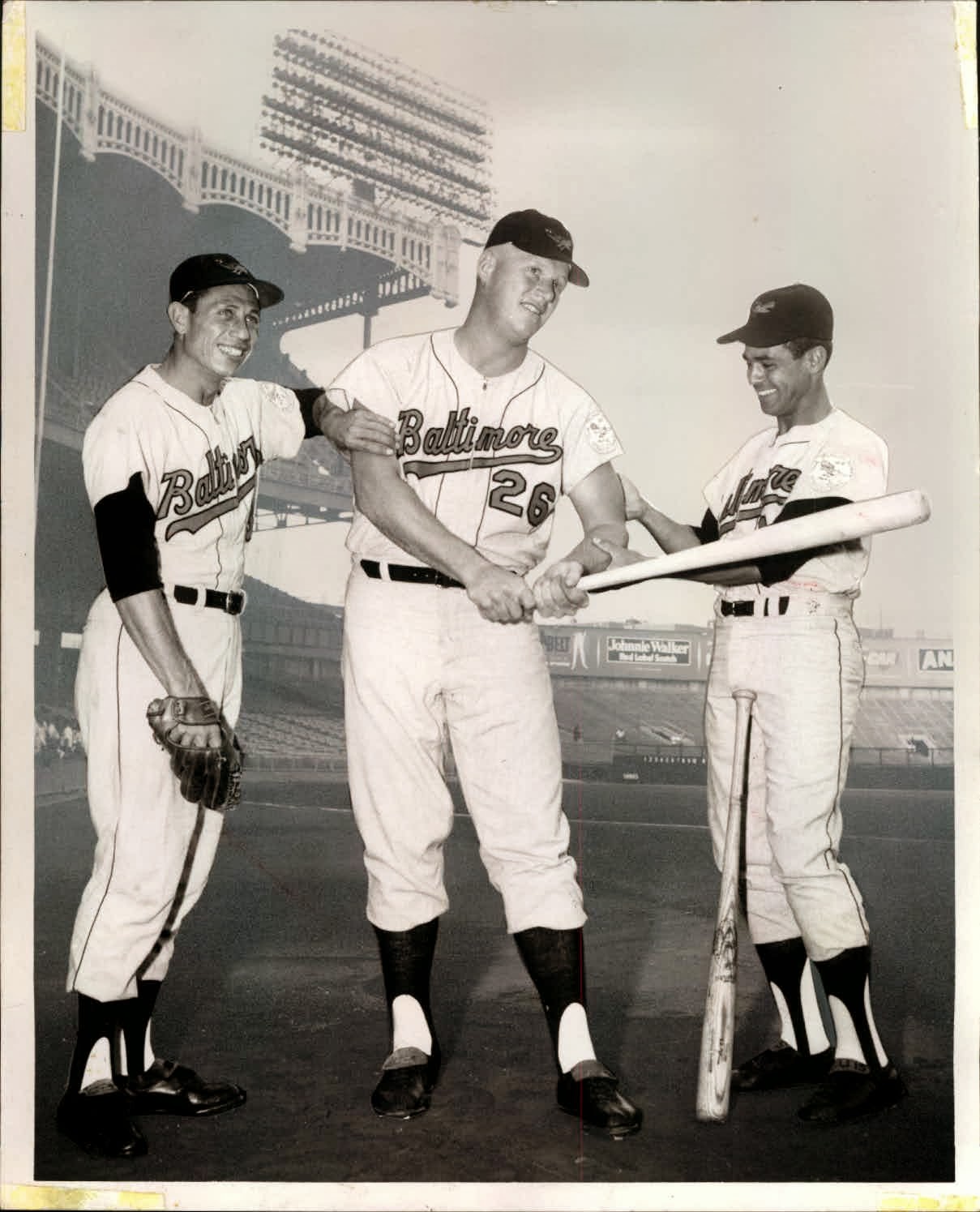
Here is a great publicity still of Boog taken in 1964 with Oriole Teammates Harvey Haddix and Luis Aparicio. They were posed with Big Boog because they were the smallest Orioles on that club.


Saturday, October 19, 2013

#83 Charley James


Hi Charley..err...Charlie...ummm...which is it? Topps didn't seem to know exactly but nevertheless here is Mr. Charley/Charlie James in all his colorful 1963 card glory. Since he autographed cards with 'Charlie' I'm going with that.

James was a Missouri boy all the way. Raised in a Webster Groves near St. Louis he was a prep baseball and football star who lettered in football at the University of Missouri. A thigh injury that landed him in the hospital got him to thinking about how football threatened his intended baseball career so he left to play pro ball. (He later received his degree from Washington University of St. Louis.)

Signed by the hometown Cardinals in 1958 he showed enough pop and promise to earn an extended trial with the club in August of 1960. From 1961 through 1964 he played the outfield for the Redbirds if not full time, then something close to it. He hit in the .260s or so in the three years he played as a 'mostly regular/fourth outfielder' but by 1964 his playing time diminished as his average fell off and the Cards decided a guy by the name of Lou Brock fit their plans in leftfield better. He stayed with the Cards long enough to earn a World Series ring in '64, pinch hitting three times in the Series, but was traded off to the Reds that winter.

After a year in which he served as a pinch hitter off the Reds' bench he was out of the game. Here is a fun blog entry detailing a 1962 game that was billed as a Bob Gibson vs. Sandy Koufax showdown that didn't turn out that way and was the game that saw James his his only career grand slam. It came off the great Koufax.

But back to the Charlie v. Charley thing. Topps seemed to have a difficult time deciding. Here are James' other cards (images from the net):

1960 'Charley' James. He was Charley front and back on his rookie card.

1961 saw him still as Charley on both sides of his card.


By 1962 he'd become 'Charlie'. Note that he signs his name that way.


Ok, it's '63 and we are back to 'Charley'.


In '64 he was both. 'Charley' on the front, 'Charlie' on the back. 


And finally, on his last card in 1965 Topps goes out with a bang by reverting to 'Charlie' front and back. 


Of course none of this matters to anyone except me and perhaps Charlie who, btw, is still talking and thinking baseball.