Monday, August 27, 2012

Bob Schmidt (#94)

Bob Schmidt was signed by the New York Giants in 1951, and played 2 seasons in the minors before missing the 1953-54 seasons while in military service. He returned for 3 more seasons in the minors, including the triple-A Minneapolis Millers in 1957, where his teammates included Felipe Alou, Orlando Cepeda, Jim Davenport, and Eddie Bressoud.


Bob cracked the Giants' starting lineup as a rookie at the start of the 1958 season, starting 107 games behind the plate and making the all-star team. The following season, he alternated with journeyman Hobie Landrith, making 56 starts to Hobie's 88. This arrangement continued in 1960, although Schmidt had the upper hand, starting 98 games.

In late April 1961, Schmidt and 2nd baseman Don Blasingame were traded to the Reds for catcher Ed Bailey. Bob occupied the 3rd-string slot behind rookies Jerry Zimmerman and Johnny Edwards, then was traded to the Senators in the off-season.

Schmidt's playing time increased in Washington, as he shared the job with Ken Retzer in 1962. The following season, the team acquired veteran Don Leppert from Pittsburgh, and Bob's old friend Hobie Landrith from the Orioles. This limited Bob to 9 appearances, and on May 8th he was sold to the Yankees.

Schmidt spend the rest of 1963 and all of 1964-66 playing for the Yankees' AAA teams, except for 20 games with the Yankees during the first 2 months of 1965.

After missing the 1964 Topps set, his final card was issued in the 1965 set.

Friday, August 3, 2012

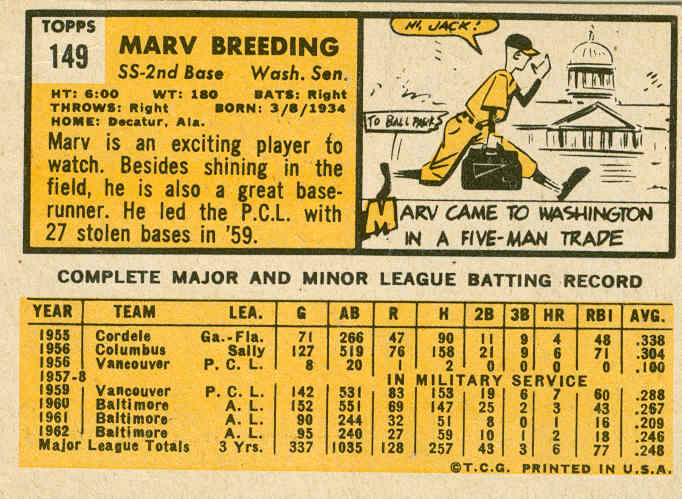
Final Card: Marv Breeding

Marv Breeding (#149) had a very short major-league career (1960-63). He was signed by the Orioles in 1955, and spent 2 seasons in the low minors before missing all of 1957-58 while in military service. He returned in 1959, where he collected 603 plate appearances as the regular 2nd baseman for the Orioles' triple-A Vancouver club.


Marv started 151 of 154 games at 2nd base for the Orioles as a rookie in 1960. He hit .269, but also committed 18 errors - 2nd on the team behind shortstop Ron Hansen's 29. The following season, Breeding shared the 2nd base job with rookie Jerry Adair, with Marv getting about 40% of the starts.

In 1962, Adair moved over to shortstop, but that didn't help Marv. Veteran Johnny Temple was acquired by the Orioles, and started 71 games at 2nd base to Marv's 56 starts. Breeding also appeared in another 40 games as a substitute and/or pinch-hitter.

After the season he was traded to the Senators, where he began the '63 season as the starting 2nd baseman. He soon lost his job to Chuck Cottier, and on June 30th was traded to the Dodgers for veteran pitcher Ed Roebuck. Marv finished out the '63 season with the Dodgers, but never played in the majors again.

He spent the 1964-68 seasons in the minors, playing for 8 organizations in 5 years, including a return to the Orioles' organization.

Saturday, July 14, 2012

Final Card: Chuck Essegian

This is the final card for Chuck Essegian (#153). Chuck played for 6 teams in his 6-year career. (I wonder if he ever unpacked?)

Chuck began his career in 1953, playing for various unaffiliated minor-league teams for 4 seasons, until he was drafted by the Cardinals in December 1956. They must have had 2nd thoughts, as he was released the following day.


Essegian was picked up by the Phillies in March 1957, and played all season in their farm system with the Schenectady Blue Jays (A) and Miami Marlins (AAA). Chuck made his major-league debut with the Phillies in April 1958. He played 39 games with the Phillies that season, but spent most of the year back in Miami.

After the 1958 season he was traded to the Cardinals for shortstop Ruben Amaro Sr. Chuck didn't have time to settle in, as he was traded to the Dodgers in June. He played for 4 teams in 1959: Cardinals, Dodgers, and the AAA teams for both clubs.

Essegian finally avoided the minors beginning in 1960. He spent the entire season with the Dodgers, although only appearing in 52 games. The Orioles purchased him before the 1961 season, but after only 1 game he was traded to the Athletics (with pitcher Jerry Walker) for pitcher Dick Hall and (future manager) Dick Williams.

Chuck's stay with the Athletics lasted 3 weeks, until he was sold to the Indians in early May. He was the backup at all 3 outfield positions in 1961, but made 85 starts in left field in 1962, sharing the position with Al Luplow.

1963 would be Chuck's last season in the majors. He was traded back to the Athletics (again for pitcher Jerry Walker) and made 51 starts in left field for KC (none after July 21st), finally losing his job to Manny Jimenez and rookie Ken Harrelson.

Essegian played in Japan for the 1964 season.

Saturday, June 23, 2012

Jim Umbricht (#99)

Jim Umbricht was a relief pitcher in the early 1960s with the Pirates and Houston Colt .45s.

He began his pro career in 1953, playing for unaffiliated teams in '53 and '56 (missing 2 seasons in the military). After the 1956 season, he was sold to the Milwaukee Braves. After 2 seasons in the Braves' system, Jim was traded to the Pirates, making his major-league debut in September 1959.

After 2 more seasons bouncing between the Pirates and the minor leagues, Umbricht was selected by Houston in the expansion draft, and spent 2 seasons in their bullpen.

 
The 1963 season was his last, as at the start of spring training he was diagnosed with melanoma. After surgery in March to remove a tumor, he made it back to the active roster for opening day, and pitched the entire season for the Colts. His situation helped to raise awareness of the disease. Umbricht compiled a 4-3 record over 76 innings in 1963.

His health deteriorated soon after the season ended, and the team released him in December. After being in and out of hospitals for much of the winter, he finally passed away at age 33 on the day before the 1964 season. Jim's body was cremated, and his ashes spread over the construction site for the Astrodome. The Astros retired his number in 1965.


 [The Astros' relatively brief history seems to be filled with tragedies. After Jim Umbricht, ex-Astros' outfielder Walt Bond died of leukemia in 1967, a few months after playing for the Twins; pitcher Don Wilson died of carbon monoxide poisoning in the off-season before the 1975 season; J.R Richard suffered a stroke just prior to a game in 1980; and more recently, ex-Astros pitcher Darryl Kile died while a member of the Cardinals.]

Friday, June 8, 2012

Dallas Green (#91)

Here's Phillies' pitcher/lifer Dallas Green.

Green was signed by the Phillies in 1955 and pitched in the minors for 5 1/2 seasons before making his major-league debut in June 1960. Dallas was a spot starter/reliever for the Phillies for the next 3 1/2 seasons. In the Phillies' near-miss 1964 season, Green split his time between the Phillies and their AAA team in Little Rock, Arkansas. 


Green was sold to the Senators at the start of the 1965 season, but was returned a month later. He spent the remainder of that season, and most of the 1966 season with the Phillies' AAA team. In August 1966 Dallas was sold to the Mets, but once again returned to the Phillies after a month. His final season as a player was in 1967, where he split his time between Philadelphia and double-A Reading, before the Phillies released him in mid-September.

After his playing career, Green worked in the Phillies' farm system under Paul Owens. When Owens became the team's GM in 1972, Green moved up to Farm Director. Under Owens' and Green's watch, the Phillies developed Larry Bowa, Greg Luzinski, Mike Schmidt, Bob Boone, and others. Dallas became the team's field manager when Danny Ozark was fired in 1979.

After leading (driving?) the team to their first World Series championship, Dallas moved on to the Cubs, as President and GM. After some high-profile stints managing the Mets and Yankees, he returned to the Phillies' organization as an adviser to the general manager.


Dallas Green's granddaughter was the young girl killed during the January 2011 shooting of a congresswoman in Tucson, Arizona.